
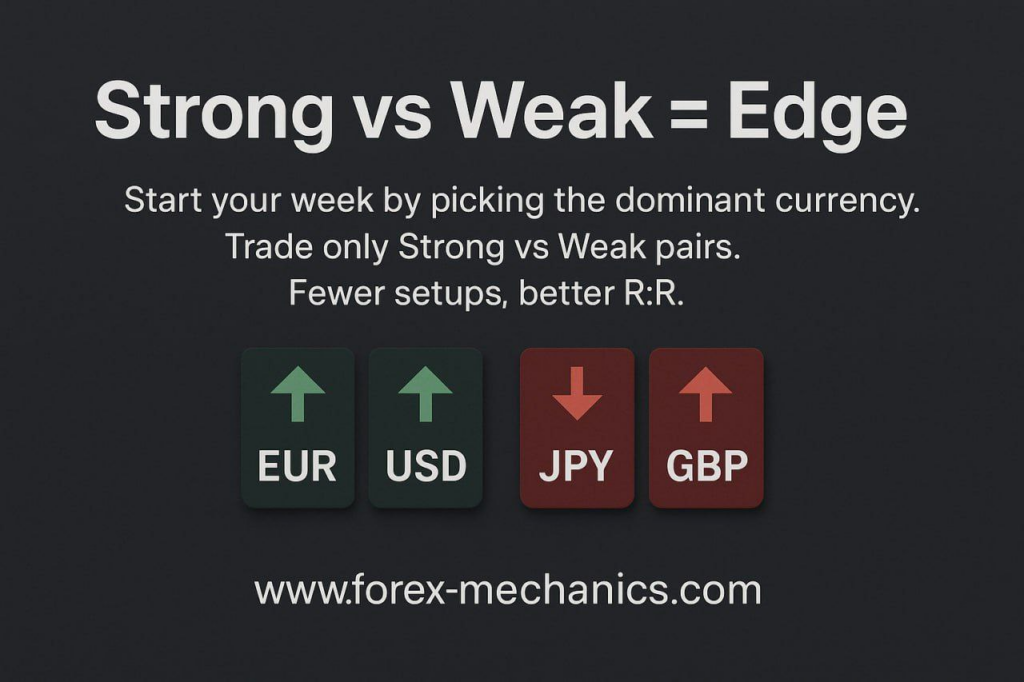
Forex trading attracts millions of participants every year.
Yet, only a small percentage remain consistently profitable.
This isn’t because traders are unintelligent or lazy.
It’s because most of them are trained to focus on the wrong things.
At Forex Mechanics, we believe traders don’t lose because of lack of effort
they lose because they fight market forces they don’t understand.
Let’s break down why most forex traders lose, and how understanding currency strength and weakness changes everything.
The Hard Truth: Most Traders Trade Blind
The average retail trader:
- Opens a chart
- Applies indicators
- Looks for patterns
- Clicks buy or sell
What’s missing?
Context.
Most traders have no idea:
- Which currency is strong
- Which currency is weak
- Where institutional money is flowing
- Whether their trade aligns with higher timeframes
They are trading price patterns in isolation, not market dynamics.
Mistake #1: Trading Pairs Instead of Currencies
Retail traders think in pairs:
“EURUSD looks bullish”
“GBPJPY looks oversold”
Professional traders think in currencies:
“EUR is gaining strength, JPY is losing strength”
This distinction is critical.
A forex pair is simply a relationship between two currencies.
If you don’t understand the strength of each side, you’re guessing.
Most losing trades come from:
- Buying a weak currency because a pattern looks good
- Selling a strong currency because RSI is overbought
- Ignoring broader currency flows entirely
Mistake #2: Fighting Strength Instead of Aligning With It
One of the most common losing behaviours is counter trend trading.
Traders:
- Sell strong currencies because they “can’t go higher”
- Buy weak currencies hoping for a reversal
- Fade trends without confirmation
Markets don’t reverse just because they look extended.
They reverse when strength shifts.
Until then, strong currencies often remain strong far longer than expected and weak ones continue bleeding.
Mistake #3: No Multi Timeframe Perspective
Another reason traders lose is timeframe conflict.
For example:
- Buying on H1 while the Daily currency flow is bearish
- Scalping against Weekly strength
- Ignoring Monthly direction completely
When higher timeframes are misaligned, lower timeframe setups fail more often.
Strength based traders avoid this by asking:
- Is this currency strong on Daily?
- Is it also strong on Weekly or Monthly?
- Is weakness consistent on the opposite currency?
Alignment increases follow through.
Conflict increases noise.
Mistake #4: Over Reliance on Indicators
Indicators are tools not decision makers.
Most indicators:
- Lag price
- Measure past behaviour
- React after the move has started
Without strength context, indicators:
- Generate false signals
- Encourage early exits
- Promote overtrading
This is why many traders feel:
“The setup was perfect, but it still failed”
The setup wasn’t wrong the market context was.
How Currency Strength Fixes These Problems
Currency strength flips the entire trading approach.
Instead of asking:
“Is this a buy or sell signal?”
You start asking:
“Which currencies deserve my capital today?”
Here’s what changes when you trade strength first:
1. Pair Selection Becomes Logical
You stop forcing trades and start focusing on:
- Strong vs weak combinations
- Clean directional bias
- Fewer, higher quality setups
2. Trends Become Easier to Hold
When you’re aligned with strength:
- Pullbacks feel safer
- Targets feel realistic
- Emotions reduce dramatically
3. Losses Make More Sense
Losses are part of trading but with strength alignment:
- You lose in the right direction
- Drawdowns stay controlled
- Recovery becomes systematic
Strength Is Not a Signal It’s a Filter
This is important.
Currency strength does not tell you:
- Where to enter
- Where to place stops
- When to take profits
What it does is decide:
- Which trades are worth taking
- Which trades should be ignored
At Forex Mechanics, strength acts as a gatekeeper.
Only trades aligned with strength, structure, and volatility are allowed.
Why Most Traders Never Fix This
Many traders:
- Keep changing indicators
- Chase new strategies
- Look for “holy grail” systems
Very few step back and ask:
“Am I trading with the strongest forces in the market?”
Strength based trading requires:
- Patience
- Selectivity
- Discipline
And that’s exactly why it works.
Final Thoughts
Most forex traders don’t fail because they lack motivation.
They fail because they trade without understanding where money is flowing.
Currency strength and weakness bring clarity to chaos.
They turn randomness into structure and hope into probability.
If you fix what you trade,
learning how to trade it becomes much easier.
This is the philosophy behind Forex Mechanics.
Forex-mechanics

